
Why We Use Digital X-Rays
Digital X-rays are one of the tools that help us keep your child's visits gentle and efficient. Instead of film, a small digital sensor captures an image of your child's teeth that appears on a screen almost right away, so there is no waiting and no chemical processing.
X-rays let us see what the eye cannot: between the teeth, under the gums, and inside developing areas of the jaw. For growing children, that view matters. It helps us follow how adult teeth are forming, spot small concerns early, and plan care around your child's individual smile.
Digital imaging takes that a step further for children. The sensor is designed to work quickly, the images are captured in moments, and we take images only when they will genuinely help your child's care. Children who squirm or get restless benefit most, because the process is over before they know it.
- Low-dose digital imaging
- Images appear on screen within moments
- No film or chemical processing
- Viewed together with you during the visit
- Taken only when they support your child’s care
When Digital Imaging Helps Your Child
A digital X-ray may help when a concern is hidden between teeth, when the dentist is following developing adult teeth, or when an exam alone cannot answer an important question. The recommendation depends on age, dental history, symptoms, and what we need to understand about your child's smile.
We do not take images automatically for every child at every visit. Our team considers whether the image will change care or add useful information. If you have questions about why an image is recommended, ask us to explain what we are looking for and how the result will guide the next step.
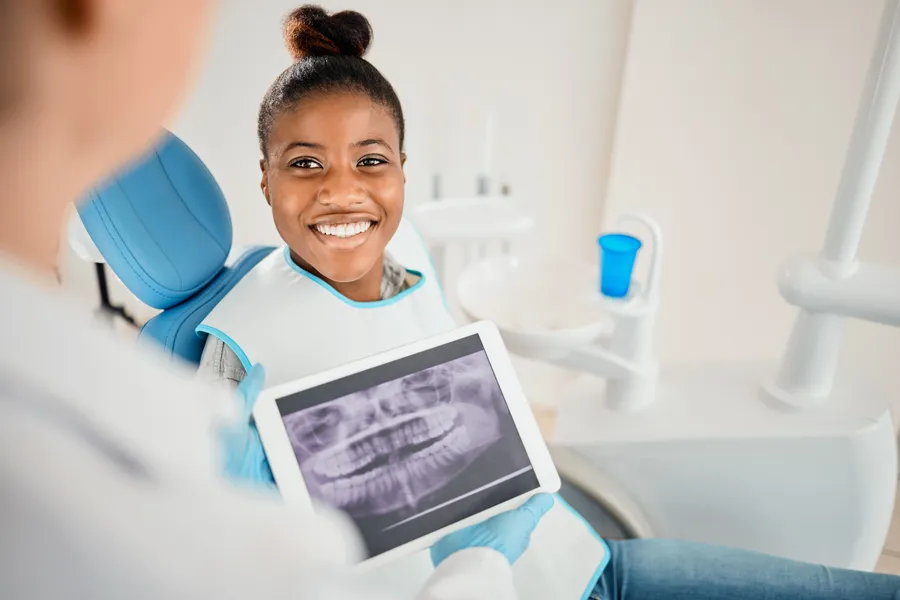
Parents can see the image on screen and talk through it with the dentist. That shared view can make a developing cavity, an emerging adult tooth, or an area that needs monitoring easier to understand. It also helps families make decisions based on what the team sees rather than on vague descriptions.

Choosing the Right Dental Image
Different images answer different questions. Small digital X-rays can show details between teeth, while panoramic or cephalometric images offer a broader view for growth or orthodontic planning. The dentist chooses based on what the exam and your child's history suggest, not on a fixed schedule for every family.
Before an image is taken, you can ask what the team is looking for and whether the result may change care. We explain the process in plain language, position the sensor carefully, and give your child a moment to practice staying still. A parent can help by using calm, simple directions.
If your child has sensory needs, a strong gag reflex, or a previous difficult imaging experience, tell us before the visit. The team can discuss positioning and pacing so the process is as predictable as possible.
What Your Child Can Expect
Get comfy
Your child settles into the chair while we explain what we are going to do in friendly, simple words.
Place the sensor
A small, smooth sensor is placed briefly in your child’s mouth while we position everything carefully.
Capture the image
The X-ray itself takes only a moment, and the picture appears on our screen almost immediately.
Review together
We look at the image with you, explain what we see, and answer every question you have.